Bar Deals

  • Subscribe to our RSS feed.
  • Twitter
  • StumbleUpon
  • Reddit
  • Facebook
  • Digg

Wednesday, 20 February 2008

Food, Frugality, and Fighting Brand Loyalty

Posted on 09:11 by Unknown
I have a confession. I’ve been writing CHG since last July, yet cooking healthily and staying on budget remain constant struggles. Though I’m learning, and hope you’re enjoying the journey, I’m ultimately not an expert chef, dietician, or personal finance guru.

But I am a media professional. And I know a little bit about advertising. And I know that the brass ring of every ad agency in existence is brand loyalty. And I know that brand loyalty can cost a food shopper (you, me, us, etc.) a lot of cash.

Today’s article focuses on that phenomenon. What is brand loyalty? When does it start? Why is it less than great? How can it be tamed? You might find the piece a bit drier than most CHG posts (in which case, pace yourself by periodically checking into Cute Overload), but it could also be the most important one yet.

(Did that sound good? Yeah? Okay, cool. Let’s get started.)

What it is
Simply, brand loyalty occurs when a consumer uses a product or service over and over again, because A) it works for her, B) it’s habitual, and C) she’s hesitant to spend cash on the unfamiliar. For example, when I buy orange juice, it’s Tropicana, and it has been for as long as I can remember. My mom always bought it, and from what I recall, her mom did, too. I rarely purchase other brands, because it’s been imprinted on my brain (through personal experience and tons of advertising) that they won’t taste as good as Tropicana.

When it begins
One of the most eye-opening moments of my professional career occurred about five years ago, when I had a meeting in a room just used by Nickelodeon. If you’re not familiar with Nick, it’s a television channel whose major target demographic is children between the ages of 4 and 11. One of their employees left a marketing presentation printout on the conference table. In it, kids (again, ages 4 to 11) were referred to as “consumers.” Yikes.

Like Nick, many (if not most) corporations start building consumer brand loyalty from birth. (It would begin at conception if zygotes could read.) Advertisers spend billions of dollars each year to promote directly to toddlers and school-age children through magazines, television shows, movies, clothes, billboards, music, commercials, and … well, you name it. The earlier marketing begins, the more ingrained the product is, and the longer those kids will be customers.

In fact, the National Institute of Media and Family estimates that “Children as young as age three recognize brand logos, with brand loyalty influence starting at age two.” If anyone has a little girl obsessed with Disney Princesses (as many of my mom-friends do), you know what they’re talking about.

Why it costs you more
Once you become loyal to a brand, that company counts on your repeat business throughout the course of your lifetime. As a result, prices can be jacked up because it’s assumed you’ll continue to pay a premium out of allegiance. What’s more, you’ll ignore competing items, no matter what advantages they present. Wikipedia puts it best: “For example, if Joe has brand loyalty to Company A he will purchase Company A's products even if Company B's are cheaper and/or of a higher quality.”

Think of it this way: there are three types of oatmeal on sale - Quaker, McCann’s, and Generi-oats. They contain mostly the same ingredients, and are essentially the same shape, color and consistency. Quaker goes for $3 a box. McCann’s is $2 after a coupon. Generi-oats runs a mere $1.50. Since it’s habit and your dear ol’ Dad always did it, you buy Quaker without thinking twice. You’re down at least $1.50 because of brand loyalty.

Now, multiply that $1.50 by the number of items in your shopping cart. How much does brand loyalty cost you per trip? Per month? Per year?

What does this have to do with the “Healthy” part of “Cheap, Healthy, Good”?
Well, advertisers throw a LOT of resources into marketing processed food, meaning you have a better chance at becoming brand-loyal. Those products are generally less nutritious than whole foods like meats, produce, and dairy, which aren’t pushed as hard in commercials and print ads. So, not only do brand-name processed foods cost more, they can crowd fresher, healthier foods out of your shopping cart.

How to fight it
While advertising and some brand loyalty are nearly impossible to avoid, there are steps you can take to minimize their influence:

EVERYDAY LIFE: Flip off the TV. Mute commercials. Try to minimize advertising found around the home. Don’t prioritize brand names, especially in front of kids. Promote media literacy. Stress variety and try new things.

FOOD: Buy generic. Experiment with brands besides the ones you regularly use. Shop with coupons, which offer savings on a different brand each week. Use the circular, which varies discounts throughout the year. Cook from scratch. Purchase foods found around the perimeter of the supermarket. Cut back on brand-based cookbooks.

A caveat
You know what? Though they’re nearly twice the price, I find Ghirardelli chocolate chips tastier than Nestle. Inarguably, they make my cookies better. I’ve developed a brand loyalty to them. On the same note, I’m highly hesitant to switch my contact lens solution. Other products dry out my eyes, and I have an annoying habit of walking into sharp things when I can’t see.

There’s nothing wrong with brand loyalty if a product works for you, especially if you’ve tried the alternatives. It’s when that devotion is uninformed and automatic there can be an issue.

In the end
Brand loyalty isn’t catastrophic, and it won’t ruin any lives or hopes for the future (like say, smoking or riding the M Train naked). While it can be costly, both nutritionally and wallet…ally, knowing the facts and shopping smart is a stellar way of addressing concerns. If you’re interested in learning more, check out these resources:
  • Answers.com provides a deeper explanation of brand loyalty.
  • For hardcore shopping statistics, there’s this About.com article, and more from the Grocery Manufacturers of America.
  • For lots of somewhat frightening information on kids and advertising, check out the National Institute on Media and Family’s fact sheet.
(Photos courtesy of Global Package Gallery, The Wooden Porch, and Flickr member aqualilflower.)
Read More
Posted in Buying Food, Frugality, Health | No comments

Tuesday, 19 February 2008

Tuesday Megalinks

Posted on 08:11 by Unknown
Bitten: Eat Your Brownies, er Veggies
Mark Bittman layeth the smacketh downeth on the Deceptively Delicious/Sneaky Chef shenanigans. At last glance, the comments were up to 88. Not that people are passionate about this or anything.

Clever Dude: An Illustrated Frugal Lunch
Have you ever wanted to see 25 peanut butter and jelly sandwiches all at once? Lined up? IN A ROW? Clever Dude has ‘em, along with plans for a month of lunches.

Culinate: Discovering Winter’s Greens
Wherein the Fab Four of February (endive, frisee, escarole, and watercress) get their long-awaited due.

Culinate: Michael Pollan has Tips for You
“Eat food. Not too much. Mostly plants.” It’s author Michael Pollan’s mantra, and here he has eight more glorious nutrition tips.

Epicurious: Kitchen Tricks – Peeling Butternut Squash
Thank goodness someone has a system for this, because every time I try to hack through one of these things, images of Monty Python’s limbless Black Knight limp through my head. (“Your arm’s off.” “No it isn’t.”) Thanks to Slashfood for the link.

Festival of Frugality #113: Mighty Bargain Hunter

MBH goes with a U.S. mint theme for this week’s FoF, and CHG receives the George Washington designation. That means I chop down cherry trees and have wooden teeth. Also, there’s that Father of the Country thing. Neat.

Like Merchant Ships: 1950’s Budget Menu
A.k.a. Everything You Always Wanted to Know About Tip Roast but Were Afraid to Ask. Meredith purchased 1957’s Meal Management cookbook from Goodwill, and it’s inspired her to try a full seven days of Eisenhower-era meals. Really neat experiment, and I’m dying to read her thoughts toward the end of the week.

Make it From Scratch Festival #52: This Wasn’t in the Plan
MifS is a year old today! Happy birthday, you gorgeous festival, you. And thanks to Stephanie for keeping it up and running.

Mommy Gets Paid: More Bang for your Coupon Buck
Great, extensive post on squeezing the most from your stash.

Serious Eats: Breakfast for a Crowd – Any Ideas?

These threads are so handy. Head on over and have your say, or just collect ideas about feeding a small battalion.

The Simple Dollar: Using SuperCook to Save on Your Grocery Bill
Trent explains it best: "Just start entering ingredients in the upper left and it will start listing recipes on the right. Every time you add another ingredient, it finds recipes using only those ingredients and only a minimum of additional items.” There are other sites like it, but this appears to be the winner so far.

The Simple Dollar: Review of In Defense of Food

It’s all Michael Pollan, all the time this week, as the release of his new book means the health guru is making the press rounds. Word is, if In Defense of Food is half as good as The Omnivore’s Dilemma, he's got himself another winner.

Slashfood: Great Food Fast – Cookbook of the Day
I gaze lovingly at this cookbook nearly every time I peruse the Union Square Borders. Has anyone out there tried it? Is it really as simple and mouth-watering as the pictures look? Do tell.

Wise Bread: How I Grocery Shop
The WB’s Catherine Shaffer continues Lynnae and Kacie’s Describe Your Shopping Methods challenge.

(Photos courtesy of markbittman.com, scene-stealers.com, and Flickr member Fynbos Ridge.)
Read More
Posted in Links | No comments

Monday, 18 February 2008

Roasted Red Pepper, Artichoke, Olive and Parmesan Frittata: Hello, Gorgeous

Posted on 08:56 by Unknown
I’m way excited about today’s frittata recipe for two reasons:
  1. We made it twice this weekend. Saturday’s version was the experiment, and calling it unidentifiable would be an act of charity. But after a few spot-on adjustments (if I do say so mahself), Sunday’s frittata looked and tasted like briny, eggy victory.
  2. My food pictures are halfway decent, meaning they don’t look like they were taken by a blind man at the bottom of a well.
The beauty of homemade frittatas (besides their actual beauty – seriously, scroll down and look at that thing) are their speed and price, especially compared to restaurant versions. Those babies will run you $7 to $12, not to mention the cost and time of transportation. What’s more, besides “Sheboygan,” “photosynthesis,” and “googly,” “frittata” is one of the most fun English-language words to say over and over again out loud (until someone hits you in the head with a hammer).

This particular frittata is a reduced-fat mutant hybrid of a Health.com dish, Alton Brown’s basic recipe, and my personal taste. It’s substantial without being heavy, and the combo of peppers, artichokes, and olives brings a quasi-Mediterranean flavor that The Boyfriend and I really dug. If you’re adamantly opposed to any of the vegetables, various others can be substituted in super-easily. In fact, Cooking Light has about 35 different frittatas that beg for a few games of mix-and-match.

One possible caveat: there will be plenty of leftover ingredients after the frittata is finished. I don't see this as a drawback, though. Pourquoi? Well, paired with a head of lettuce, they’ll make six killer salads. Slapped between six pieces of toast, they’re three salivation-worthy sandwiches. Grouped with six more eggs, they're another frittata. Or, maybe? If you’re feeling saucy, there’s absolutely nothing wrong with eating the unused red peppers and olives with your bare hands, taking care to slurp your fingers to the bone afterward.

Before you commence lickery, however, take a gander at these pictures. They're the closest I might ever come to Pioneer Woman and Smitten Kitchen, and they're giving me a weird welling-up sensation. I think it might be pride. (Insert "No, it's definitely gas" joke here.)

Roasted Red Pepper, Artichoke, Olive and Parmesan Frittata
Serves 4
Adapted from Health.com and Alton Brown.

4 large eggs
2 large egg whites
¼ cup grated parmesan cheese
salt and pepper
½ Tablespoon extra virgin olive oil
1 cup minced onion
1 roasted red pepper, chopped
2 canned artichoke hearts, chopped into eight pieces each
1 T chopped fresh parsley
8 kalamata olives, sliced

1) Preheat your broiler.

2) Whisk eggs, parmesan, and salt and pepper to taste together in a small bowl.

3) Heat oil over medium-high heat in a medium-sized oven-proof pan. Add onion and cook about 3 minutes, until translucent. While this is happening, pat down the red peppers, artichoke hearts and olives with a paper towel to remove some of the moisture.

4) Turn heat down to medium and add eggs. Without stirring, let eggs set for about 3 minutes.

5) When sides of frittata start to set (they’ll begin pulling away from the pan), sprinkle roasted red pepper, artichoke hearts, parsley, and olives evenly on top. Cook for about 2 or 3 minutes more, until the top just starts to set.

6) Transfer pan to broiler and cook until top becomes light golden brown. This should take about 3 minutes, but check after 2 since broilers are different the world over.

7) Using a potholder, remove pan from broiler and set on top of stove. Loosen frittata with spatula immediately (otherwise it will continue to cook), being careful not to tear the eggs. Plate and eat.

Approximate Calories, Fat and Price per Serving
159.5 calories, 10.1 g fat, $0.81

Calculations
4 large eggs: 294 calories, 19.9 g fat, $0.60
2 large egg whites: 34 calories, 0.1 g fat, $0.30
¼ cup grated parmesan cheese: 86 calories, 5.7 g fat, $0.52
salt and pepper: negligible calories and fat, $0.02
½ Tablespoon extra virgin olive oil: 60 calories, 7 g fat, $0.04
1 cup minced onion: 48 calories, 0.1 g fat, $0.15
1 roasted red pepper, chopped: 31 calories, 0.4. g fat, $0.49
2 canned artichoke hearts, chopped into eight pieces each: 13 calories, 0 g fat, $0.60
1 T chopped fresh parsley: negligible calories and fat, $0.25
8 kalamata olives, sliced: 72 calories, 7.2 g fat, $0.25
TOTAL: 638 calories, 40.4 g fat, $3.22
PER SERVING (TOTAL/4): 159.5 calories, 10.1 g fat, $0.81
Read More
Posted in 15 Minutes or Less, Breakfast, Eggs, Vegetarian | No comments

Friday, 15 February 2008

Respect for the Old School: Betty Crocker’s Angel Food Cake

Posted on 08:45 by Unknown
We’ve been talking a lot about cookbooks around here the last week. On my end, it’s been super fun and educational, but it’s also made me very, very hungry. Like, I’ve-been-gnawing-on-my-hand hungry. (It’s delicious, if anyone wanted to know.) To sate this ravenous yen - for puffy, sugary things in particular - I decided to break out some Betty.

Betty Crocker’s New Cookbook: Everything You Need to Know to Cook was my very first cookbook. Or at least, the first one I used with any regularity. It had everything a poor, culinarily challenged college student needed in 1998: big pictures, easy directions, and cheap ingredients. (Er, nutrition wasn’t really an emphasis at that point. My metabolism was firing on all cylinders.) Some of the recipes were fairly impressive, too, at least at the time: Stuffed Peppers, Szechuan Pork, and of course, Pepperoni Pizza-Hamburger Pie (a.k.a. 20-Year-Olds Having Heart Attacks? This Makes it Possible Pie).

The zenith of Betty’s gastronomic masterpiece was, and continues to be, the Angel Food Cake. It’s airy, it’s sweet, it’s company-appropriate, and best of all, it’s fat-free. I’ve tried other versions (including Alton’s, which surprisingly bombed), but keep coming back to Betty. If you choose to accept her Angel Food mission, I might make the following suggestions:

1) This type of cake needs a very specific pan, which you can procure for a few bucks at any kitchen equipment store. A cheap one will last years (mine’s going on 11), so there’s no need to break the bank.

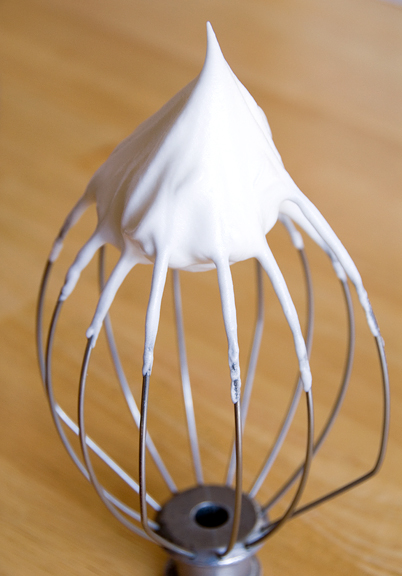
2) When the recipe calls for stiff peaks, it means stiff peaks. Underbeaten batter will result in a brick. It takes me many, many minutes of high-speed beating to accomplish this.

3) “Folding” means: “to gently cut down through center of egg whites, along bottom and up side of bowl; rotate bowl a quarter turn. Repeat.” Here’s another brief description from Kathleen Daelemans.

4) The recipe calls for cake flour. I use all-purpose flour (and always have). It works.

5) If you don’t have almond extract, use 2 teaspoons of vanilla. It works, too.

6) There will be something like 12 egg yolks left over from the cake. Don’t throw ‘em away! Instead, try one of the suggestions in this Serious Eats thread. (Perhaps a hollandaise sauce, madam?)

Miss Betty provided the fat and calorie information, so only the price computations are included below. Happy caking, everybody!

Angel Food Cake
Makes 16 servings
Adapted from Betty Crocker’s New Cookbook: Everything You Need to Know to Cook.

1-1/2 cups powdered sugar
1 cup cake or all-purpose flour
1-1/2 cups large egg whites (about 12)
1-1/2 teaspoons cream of tartar
1 cup granulated sugar
1-1/2 teaspoons vanilla
½ teaspoon almond extract
¼ teaspoon salt

1) Preheat oven to 375ยบ F and drop oven rack to the bottom rung.

2) In a medium bowl, combine powdered sugar and flour.

3) In a separate large bowl, "beat egg whites and cream of tartar on medium speed ... until foamy." Turn mixer to high and very slowly add granulated sugar (about 2 tablespoons at a time) into bowl. Once the sugar is all in, immediately add vanilla extract, almond extract, and salt. Keep beating until you get stiff peaks (which will be "meringue-like" and "glossy"). For the love of Pete, DO NOT UNDERBEAT.

4) Slowly fold flour mixture into egg white mixture, 1/4 cup at a time, "just until sugar-flour mixture disappears." When finished, push everything into an ungreased, standard-size angel food cake pan (a.k.a. tube pan). Using a butter knife, gently slice through the mixture a few times. This will eliminate air bubbles.

5) "Bake 30 to 35 minutes or until cracks feel dry and top springs back when touched lightly." (I also do the toothpick test. If the toothpick comes out with batter on it, put the cake back in for about 5-10 more minutes.) Remove from oven and quickly flip pan upside down. Rest on a soda bottle, beer bottle, or even a plate,  making sure the cake doesn't touch the plate. Keep it there for a minimum of 2 hours. Cake should be totally cool when you flip it back over. Gently "loosen side of cake with knife or long, metal spatula" to get it out of the pan. Serve.

Approximate Calories, Fat, and Price per Serving
130 calories, 0 g fat, $0.21

Calculations
1-1/2 cups powdered sugar: $0.43
1 cup cake or all-purpose flour: $0.05
1-1/2 cups large egg whites (about 12): $1.79
1-1/2 teaspoons cream of tartar: $0.55
1 cup granulated sugar: $0.33
1-1/2 teaspoons vanilla: $0.18
½ teaspoon almond extract: $0.06
¼ teaspoon salt: $0.01
TOTAL: $3.40
PER SERVING (TOTAL/16): $0.21
Read More
Posted in Desserts and Snacks, Vegetarian | No comments

Thursday, 14 February 2008

CHG Favorites of the Week: The Slightly Off-Topic Valentine's Day Edition

Posted on 11:50 by Unknown
AIEEEEE! of the Week
Indiana Jones and the Kingdom of the Crystal Skull
Okay, so it’s not about food. That is, unless you consider Harrison Ford, who is a tasty morsel at … 65? HARRISON FORD IS 65? Oh man. Take care of yourself, Han.

Blog of the Week

John Scalsi’s Whatever: Being Poor
JD posted this yesterday, but it’s important and moving enough to post again. Please pass it on, and don’t miss the comment section.

Organization of the Week
Association for India’s Development
“The Association for India's Development (AID) is a volunteer movement committed to promoting sustainable, equitable and just development. In solidarity with non-violent people's struggles, AID supports grassroots organizations in India and initiates efforts in various interconnected spheres such as education, livelihoods, natural resources, health, women's empowerment and social justice. Founded in 1991, AID has 36 chapters in the United States, approximately 1,000 volunteer, has supported 365 projects, and has 100 ongoing projects.” – Charity Navigator description

Quote of the Week
“I gotta work out. I keep saying it all the time. I keep saying I gotta start working out. It's been about two months since I've worked out. And I just don't have the time. Which, uh … is odd. Because I have the time to go out to dinner. And, uh … and watch TV. And get a bone density test. And, uh ... try to figure out what my phone number spells in words.” – Ellen DeGeneres

Tip of the Week
This is less of a tip than a VERY IMPORTANT WARNING: always, ALWAYS wear gloves when mincing hot peppers. Today marks the one-year anniversary of Capsaicin Day, a.k.a The Time I Chopped Three Jalapenos, Three Poblanos, and Three Anaheims with My Bare Hands and Wanted Tear My Skin Off for the Next 18 Hours. If you’ve ever done this before, you know you should NEVER, EVER do this. It produces a less-than-pleasing chemical burn sensation that no salve, medicine, or frozen yogurt bath can fully conquer. I missed a day of work, and felt like a consummate dummy afterward. So please, wear gloves. (And for pete’s sake, don’t rub your eyes. And especially don't go to the bathroom.)

Untried Recipe of the Week
Roasted Garlic at The Pioneer Woman Cooks
Sure, roasted garlic is pretty basic, but PW’s pics makes it look like a work of art. Commence drooling.

Video of the Week
“Choux Pastry Heart” by Corinne Bailey Rae
This isn’t the official video (since there isn’t one), but rather a collection of Corinne footage comped by an anonymous You Tuber to back the song. As those kinds of things go, it isn’t bad. AND it means you can listen to “Choux Pastry Heart” anytime you like. Which you should. A lot. Because it’s pretty.

(Photos courtesy of alreadyseen.com and Flickr member le monde est beau.)
Read More
Posted in Links | No comments

Wednesday, 13 February 2008

The Dos and Don’ts of Buying a Cookbook

Posted on 07:18 by Unknown
The backbone of your kitchen, they stand at attention on the countertop like so many colorful soldiers, straight-spined and ready for employment at their commander’s behest. They are your cookbooks, and by gum, eating well would be dang near impossible without them.

Today, we’re discussing those culinary/literary stalwarts, and how to buy the best possible tomes for your needs (or someone else’s). And by “we,” I mean CHG and Casual Kitchen. CK creator Dan asked Meredith from Like Merchant Ships, Hannah and Phoebe from I Heart Kale, and yours truly to name their favorite tomes and describe why they deserved a special place on the bookshelf. He included his own picks too, and the final group of 12 makes a solid starter collection.

Over here, we’re listing the Dos and Don’ts of purchasing a cookbook, whether it’s one Dan mentions or another volume entirely. Now, you don’t have to follow ALL these rules every time you crave a Martha Stewart baking collection. (That would be a tad obsessive. Insane, even.) But heeding one or two guidelines could save a few bucks in the long run.

DOs

DO get recommendations from friends. There’s no better litmus test for a cookbook than hearing the good word from previous purchasers - ESPECIALLY ones you love and trust in the kitchen.

DO read reviews. Second only to the all-important friend referral, reviews let you know how a cookbook is being received by the general public (a.k.a. the people who have no stake in promoting it). Amazon and the Chowhound message boards are two spectacular destinations for (generally) unbiased evaluations.

DO match your needs. Are you a vegetarian mother of 67 who eats Italian food exclusively? Are you a young British dad who can’t get his three-year-old to swallow a single carrot? Are you a swingin’ CEO who has exactly four minutes and 15 seconds to make dinner each night? Whatever your situation, there is a cookbook to match it. If you can, take a few minutes to browse some bookshelves, message boards, or online libraries. Odds are you’ll find that 2nd edition of 30-Minute Indian Pork Desserts. (You know, the one with the Bacon-wrapped Galub Jamun?)

DO consider health concerns and dietary restrictions. This goes doubly for cookbook gifts. Case in point: the “HI Y’ALL!” cackle and planet-sized diamonds aside, I secretly love me some Paula Deen. For a brief time, I even considered replacing my blood with her Chocolate Bread Pudding. Alas, as my days of full-fat desserts and “FAHVE STI-YUCKS OF BUTTUH!” are over, a Lady and Sons hardcover might not make the best birthday present. It’s the same idea with diabetics and candy instructionals or vegans and barbecue cookbooks.

DO see the cookbook at least once in person. If you’ve ever used a color-challenged computer monitor to make online purchases, you know goods can be very different in real life than how they appear onscreen. Nothing beats seeing the dimensions, hues, and layout of a cookbook with your own beautiful blues. Take a gander next time you’re at the local Borders.

DO scan the inside flap. This excellent tip comes from About.com’s Fiona Haynes, who observes that the front and back covers provide, “a snapshot of the author, their philosophy and credentials.” If you’re concerned with authenticity or qualifications, the bio is a great place to start.

DO read the index and a few recipes. Ingredient lists, equipment availability and mastery level are three vital factors in matching a cookbook to your needs. Can you find all the required foods? Do you own (or can you procure) the appropriate utensils? Do you have the necessary skillz? Gift-wise, this step also ensures Junior doesn’t receive a Daniel Boulud collection and “30-Minute Meals for Dummies” won’t go to your gourmand grandma.

DO practice the 7-day rule. If you see a book in a store and like it, wait a week. Then, if you’re still craving its sweet, succulent food after seven days, go nuts. You can even use the downtime to check for discounts and comparison shop.

DO try out a library copy. Test driving a loaner is a failsafe method of ensuring it gels with your cooking style. Those 21 days (or 25 if you’re delinquent with returns … me) provide plenty of opportunity to experiment with recipes. And? If you’re not satisfied? You haven’t blown $20 on a waste of precious shelf space.

DO check if you can find the same recipes online for free. Why fork you’re your hard-earned cash for something you can procure for no money down? Tons of magazines and authors publish their work on websites now, and a ten-minute search could save you 30 bucks. Of course, sometimes you just want the book, and that’s totally fine, too. Even though Lidia Bastianich posts a ton of her dishes on the ‘net, I prefer having The Italian-American Kitchen around because of the convenience and extras: cooking tips, food descriptions, pictures of her hands, etc.. (Seriously, I love her hands. They just look so … capable.)

DON’Ts

DON’T be seduced by design. Too many cooking guides look gorgeous next to your backsplash, but come up short in the recipe department. If a full-color strawberry 8x10 is what you want, photography books might be a better option.

DON’T fall for too-good-to-be-true discounts. The 75% off sales at Barnes and Noble … the bargain basement prices at CostCo … the clearance markdowns at Bed, Bath, and Beyond. When it comes to cookbooks, it’s tempting to dive right into the BUY 1 GET 1 FREE bin. Unfortunately, those costs are often slashed for a reason: the recipes are duds, the layout doesn’t work, etc. You might strike gold on occasion, but it’s always safer to research first.

DON’T gift a cookbook if it will go unused. Once upon a time in her early teens, my friend S mentioned to her extended family that she liked cows. Henceforth, for a full decade, nearly every single present she received was cow-themed. Now, she wasn’t ungrateful – it’s just that she had approximately 48,000 pieces of bovine paraphernalia and had grown out of the phase by age 15. Even today, at 30, she’s occasionally given a porcelain heifer for her birthday. Similarly, I’m sure there are folks with 38,000 cookbooks who’d rather chug olive oil than get another one. (I’m also sure there are collectors with 138,000 who would like nothing better.) If you’re buying a gift, consider carefully whether the intended recipient falls into the Too Many Cows category. (Beware of giving cookbooks to non-cooks, as well.)

DON’T jump at a celebrity cookbook. A-list endorsement doesn’t always equal good eats. You might end up instantly horrified (Paris Hilton cooks?) or pleasantly surprised. By all accounts, Patti LaBelle’s soul food and the late Linda McCartney’s vegetarian dishes are solid investments, but others … who knows?

DON’T buy into suspicious gimmicks. I have no idea if all-tea diets or worm head dinners are nutritionally sound. I’m not a health professional. I DO know I wouldn’t purchase a cookbook that made shady promises about accelerated weight loss or tapping the inner mind through lemons. There are snake oil salesmen everywhere, even in the usually classy cookbook world. Doing the research and trusting your instincts can help you avoid these charlatans.

And that’s our ballgame. If anyone out there would like to add to these OR suggest a cookbook for Dan’s list, write us an e-mail or go crazy in the comment section. We look forward to hearing from you.

(Photos courtesy of lollyknit , suzysputnik, ulterior epicure and maltphoto.)
Read More
Posted in Cooking, Frugality, Organization | No comments

Tuesday, 12 February 2008

Tuesday Megalinks

Posted on 09:09 by Unknown
Tomorrow, CHG is featuring a joint post with one of the best cooking blogs out there, Casual Kitchen. Dan and I will discuss how to buy a good cookbook, and which ones would be solid basics for your home. Come on back (same bat time, same bat channel) for the excitement.

Bitten: Why I Never Buy Vinaigrette
NY Times food guy Mark Bittman started a blog! (“Food guy.” Way to use that English degree, Kris.) Here, he discusses homemade vs. store-bought dressing.

Casual Kitchen: How to Apply the 80/20 Rule to Cooking
As the business world goes, so does food prep. Minimizing input and maximizing output is a must.

Culinate: Planning meals around a pot of beans

Personable, endearing piece from ex-food critic Carrie Floyd on how she feeds her family for a week using legumes. When her kids protest, she disguises the beans’ true identities with foreign languages: “’Those aren’t beans,’ I say, ‘they’re fagioli.’ When they persist, I switch to French: ‘Haricots!’”

Culinate: Stocking up – the basics of making meat stock
In-depth look at the art of stock. It’s all in the details, man.

Festival of Frugality #112: Lazy Man and Money
Lazy Man cuts the festival down to a sleeker, more manageable size than its previous incarnations, which makes for much easier reading. Suggested: Wise Bread’s Cooking Without Crepe Pans and Other Expensive Kitchen Tools and Lightening Online’s continuing series on Reducing the Grocery Budget (which has been excellent so far.)

Gourmet: A Rooster’s Wake-Up Call
Short of setting it aflame, there’s no quicker way to add tongue-scorching heat to a meal than sriracha. Gourmet’s Alan Systma explains why the chef-approved hot sauce should be you-approved, too. (Thanks to Serious Eats for the link.)

LA Times: Parchment paper - A kitchen marvel, and cheap!
Though the world grows increasingly paperless, parchment remains a kitchen stalwart. We couldn’t cook fish en papillote, bake decent cookies, or create Native American village dioramas without it. (Thanks to Serious Eats for the link.)

Make it From Scratch Festival #51: It’s All for the Best

Good V-Day dinner ideas in this week’s MiFS Festival, hosted by Heather. For the diet-conscious, there’s a craft how-to for felt cupcakes from GreenStyleMom. (Note: I will eat anything cupcake-shaped. Felt included.)

Serious Eats: Ed Levine's Serious Diet Week 5 - Can "Start Living, Stop Dieting" Work for a Food Writer?
In which an avowed foodie wonders if a change in lifestyle can mesh with his chosen occupation. Incidentally? Whoever’s behind the current Weight Watchers campaign needs a Clio Award immediately. The "Start Living, Stop Dieting" slogan works two ways: it separates the company from gimmicky weight-loss plans AND promises people that deprivation shouldn’t be associated with healthy eating. Kudos.

Serious Eats: What to Do with 24 Leftover Egg Yolks?
Made an Angel Food cake and don’t know how to use the refuse? Join in this thread and learn about everything from lemon curd to hollandaise.

The Simple Dollar: 100 Great Tips for Saving Money for Those Just Getting Started
PHENOMENAL post. Trent goes well beyond the usual “keep a budget” routine, delving into dozens of well-thought-out beginners’ strategies. Food makes up a good 10% of the list. Pass it on. (To everyone. Even your dog.)

The Simple Dollar: What You Spend, What You Eat – The Deep Connection Between Food and Personal Finance
Wow. Dude’s on a roll.

Slashfood: Buttermilk in a pinch? Add some vinegar to your milk (and other emergency substitutions)
Short, neat list of oft-used improvisations. I never thought of adding vinegar and milk together, having always assumed it would create some kind of time-space vortex. Mmm ... vortex.

Wise Bread: Bridging the Gap from Dining Out to Eating In
Ah, yes. Beyond learning to operate a spatula, eating out has undoubtedly been my biggest foil in saving cash. Be sure to read the comments for more suggestions.

(Photos courtesy of Flickr members reya, barron, and wine-scribbler.)
Read More
Posted in Links | No comments
Newer Posts Older Posts Home
Subscribe to: Posts (Atom)

Popular Posts

Categories

  • 15 Minutes or Less
  • About Cheap Healthy Good
  • Breads
  • Breakfast
  • Buying Food
  • Chili
  • Cooking
  • Desserts and Snacks
  • Dining Out
  • Dips and Sauces
  • Do-Gooding
  • Drinks
  • Eggs
  • Frugality
  • Health
  • Links
  • Mains
  • Meat and Fish
  • Organization
  • Pasta
  • Reader Comments
  • Sides
  • Soups and Stocks
  • Vegan
  • Vegetarian

Blog Archive

  • ▼  2008 (89)
    • ▼  April (20)
      • Michael Pollan Earth Day Special
      • Tuesday Megalinks
      • Popovers and Out
      • Comments of the Week
      • Low-Fat Broccoli Cheddar Soup: Of Cheese and Rock
      • CHG Favorites of the Week
      • Cheap, Healthy Salad Dressing: 102 Light Recipes
      • Tuesday Megalinks: The Ides of April Edition
      • Mission: Light Macaroni and Cheese
      • Comments of the Week
      • Cheesy Eggplant Bake: The Power OF WORDS
      • CHG Favorites of the Week
      • The Hour: How 60 Minutes a Week Can Save Hundreds ...
      • Tuesday Megalinks: The Jayhawks Edition
      • Light Fresh Tomato Lasagna: We’ve Got the Means to...
      • Comments of the Week
      • Chicken with Shallot-Apricot Sauce: Sweet Victory
      • CHG Favorites of the Week
      • Healthy Takeout on a Budget
      • Wednesday Note
    • ►  March (26)
    • ►  February (21)
    • ►  January (22)
  • ►  2007 (123)
    • ►  December (19)
    • ►  November (21)
    • ►  October (22)
    • ►  September (20)
    • ►  August (21)
    • ►  July (19)
    • ►  June (1)
  • ►  2005 (1)
    • ►  February (1)
  • ►  2004 (1)
    • ►  February (1)
Powered by Blogger.

About Me

Unknown
View my complete profile